

When Nicolas Thomas knocked on doors during his campaign for Brossard’s District 6 seat, he could predict the reaction. Residents took one look at the Master of Urban Planning student and paused.
“People said, ‘Oh, you look young,’” recalled Thomas. “Then I told them my age and they said, ‘Wow, you are young.’”
What began as surprise often turned into encouragement after speaking with Thomas.
“A lot of people told me we need young blood,” he said. “Most of the time, people appreciated seeing someone my age stepping up.”
At 22, Thomas became the youngest elected official in Brossard’s history when he won his seat on Nov. 2 with roughly 64 per cent of the vote. He described election night as “a wave of euphoria,” shared with family, friends and supporters who had helped him canvas the district for months.
Politics from the ground up
Thomas’s path to city council did not begin in a politically driven household. Even at 12, he was more politically minded than anyone else around the dinner table, offering his own commentary as the CTV evening news played in the background.
But his family encouraged his curiosity and when Thomas was 16, his mother brought him to a coffee chat with the local Member of Parliament, Alexandra Mendès. That meeting led to his participation on a youth council and ignited a deeper commitment to public service.
He later worked as a political staffer in the office of the MNA for La Pinière, Linda Caron, gaining early experience with local democracy, public concerns and community-facing decision-making.
The new councillor’s candidacy began with a call he never expected. Shortly after Thomas finished his final undergraduate exams at McGill, Brossard Mayor Doreen Assaad phoned to invite him to run for a council seat. She told him the city needed younger voices at the table and that she believed his background in urban studies and planning made him an ideal fit for a district poised for major development.
“I was shocked,” Thomas said, recalling how he asked for the weekend to let the news sink in before accepting. “It was an honour to have her trust.”
Where politics meets planning
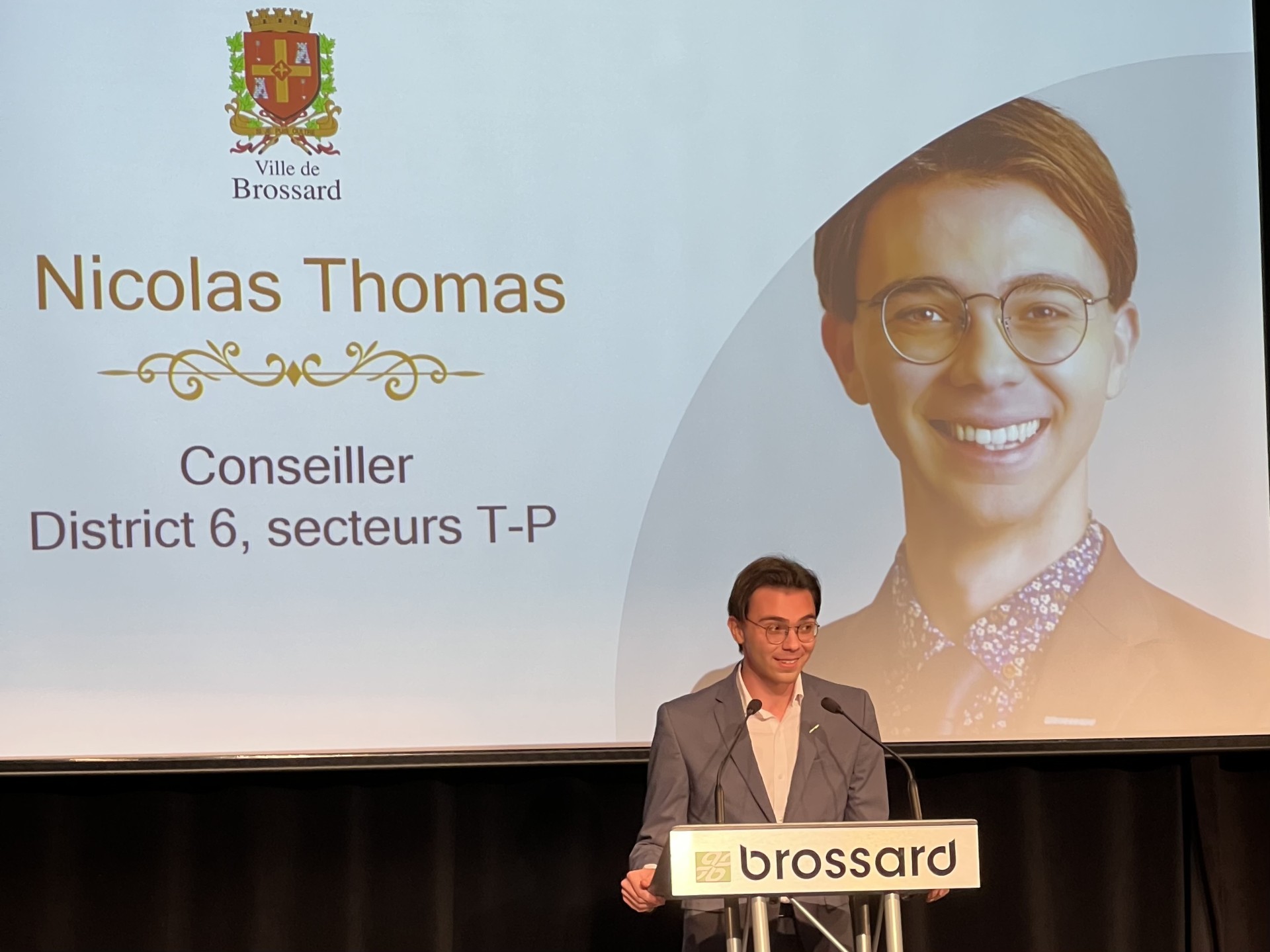
Thomas’s political instincts and academic interests have always run parallel. A McGill graduate in Honours Urban Studies, he is now in his first year of his master’s degree. His passion for maps, neighbourhoods and the design of cities began early, but he said it was his interest in politics that “pushed him toward urban planning,” not the other way around.
His dual focus is clear in his two core interests: housing and participatory planning. He speaks urgently about affordability challenges facing his generation and about finding ways to incorporate residents into the planning process.
“You can identify a problem,” he said. “But identifying the solution is harder. The best way is to listen. Maybe you won’t agree with someone, but you learn where an issue really comes from.”
His academic work already touched directly on Brossard’s future. He was author of the first university research project examining the city’s New Downtown, a major redevelopment area that includes the surroundings of the Panama REM station within his district. Now, as councillor, he will be involved in seeing the project move from planning to implementation.
As both elected official and an urban planning student, Thomas has been given a rare perspective.
“Being city councillor gives me insight into what residents expect from urban planners in their daily lives. And as a student, I’m learning from professionals with deep expertise,” he said. “I feel very lucky to experience both at the same time – and I take both roles very seriously.”
From big projects to everyday improvements
Thomas said he is still learning the ropes after only a few weeks in office, but he is clear about what motivates him: the chance to make tangible changes, from major developments to simple improvements like lighting pedestrian paths or repairing damaged walkways.
He is also conscious of the significance of his election.
“I wouldn’t be here if people didn’t believe in me,” he said. “This wasn’t done by one person. The support around me from constituents, my friends, my family and my colleagues, is what made it possible.”
For now, the young councillor is balancing council meetings with coursework; constituency work with classes. But he sees it all as connected: the theory at McGill, the practice at City Hall and the belief that residents of any age can shape their city.
“It’s an honour to serve,” he said. “And every day I’m reminded why I love this work.”