
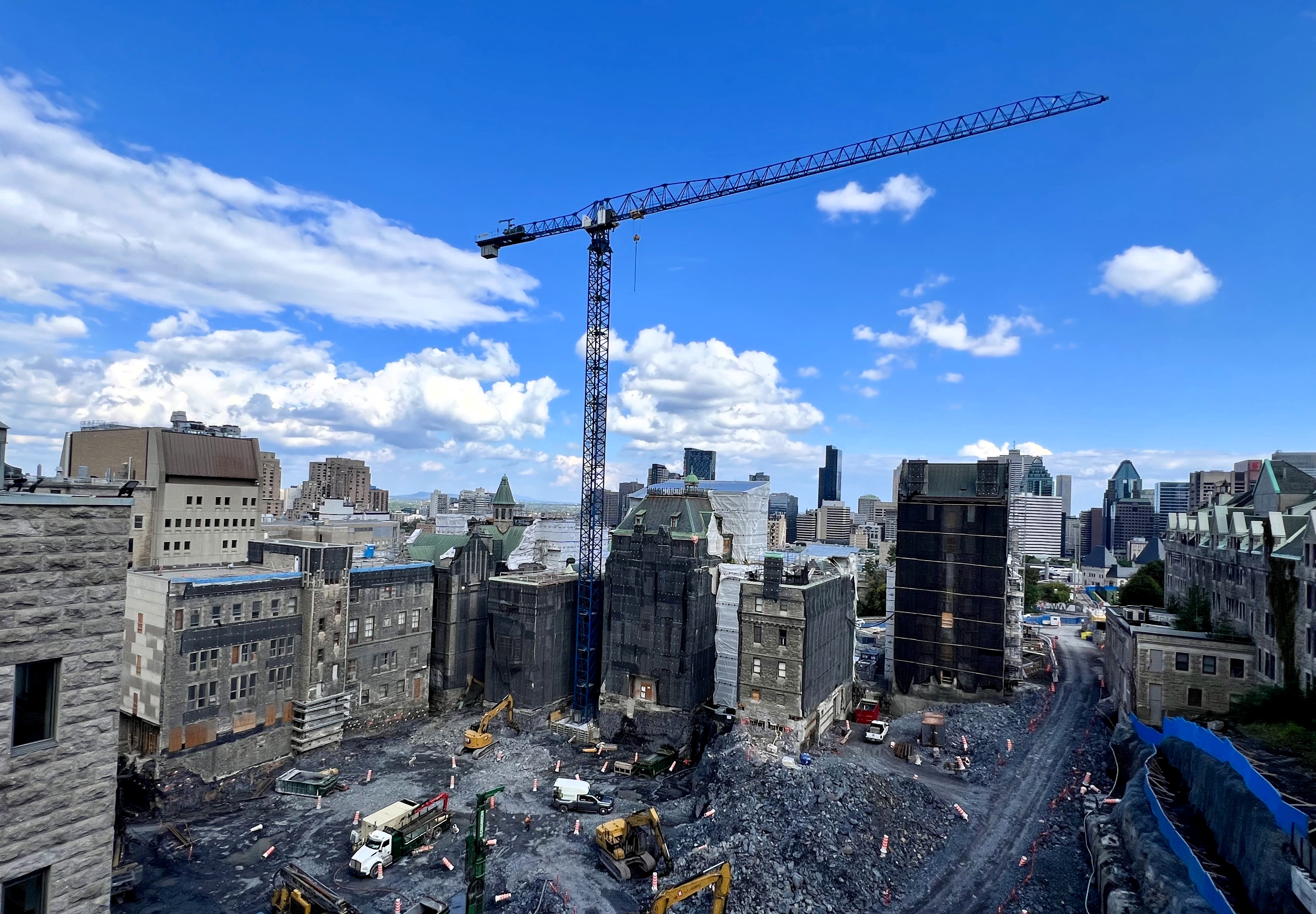
A 75-metre tower crane rising above McGill University’s Sustainability Park site signals that the ambitious project is moving into the construction phase.
“This tower crane really marks an important milestone,” said Pierre Major, executive director of the Sustainability Park. “We’re literally coming out of the ground now. We are ready to build.”
The crane will be used for formwork, moving construction materials and hauling away demolition debris. It’s the first of three that will eventually serve different zones of the site. Each will be a different size, with the one now in place being the tallest. Its 66-metre working arm can reach across much of the site and lift loads of up to 20,000 kilograms. The other two cranes should be installed by the end of the month.
Construction is expected to begin within weeks. Major said the site should be in full swing within about a month and a half.
Building beside history
The shift is particularly significant for a project that has spent years preparing the former Royal Vic site. Decontamination began in January 2022, including the removal of extensive asbestos. Demolition of the M and S pavilions followed from January to September 2023, while excavation and other preparatory work continued.
The next phase will bring a different challenge: constructing a large new building alongside three 130-year-old heritage pavilions that are being restored.
The proximity of the new construction to the existing buildings means crews must manage vibrations, excavation and other work that could affect the historic structures.
“It’s challenging to work with heritage buildings. There are specific criteria that must be respected,” said Camille Boutin, Project Manager, Pomerleau. “For example, when we excavate, we closely monitor vibrations to make sure they don’t exceed levels that could put stress on the existing structures.”
Meanwhile, masons are continuing restoration work on the heritage buildings, repairing masonry walls that had fallen into disrepair and carefully restoring the facades. Stones are being cleaned, numbered and repositioned as part of the process.
From demolition to reuse
The project’s approach to the existing site extends beyond preserving buildings. It also means finding new uses for materials that might otherwise have become waste.
McGill requires 75 per cent of demolition material from campus construction to be diverted from landfill. The Sustainability Park project has exceeded that goal, diverting 90 per cent.
Materials are sorted, weighed and tracked to determine where they can be reused or recycled. Concrete from the demolition was crushed into gravel and used for roadwork on the site. Cast-iron radiators were given to a company that cleans, refurbishes and electrifies them rather than melting down the metal. Lighting fixtures have found new homes in McGill student residences.
The project team has also recovered other materials, including door hardware, doors, steel and stone, for reuse or storage.
That emphasis on sustainability will continue as construction advances. The site will eventually feature 173 geothermal wells extending 250 metres underground, providing most of the building’s heating capacity during the winter.
For Major, the first crane is a welcome sign that years of preparation are giving way to a very different stage of the project.
“We’re very excited because there’s actually more of the infrastructure project behind us now than there is ahead of us, which is a pretty exciting place to be.”