
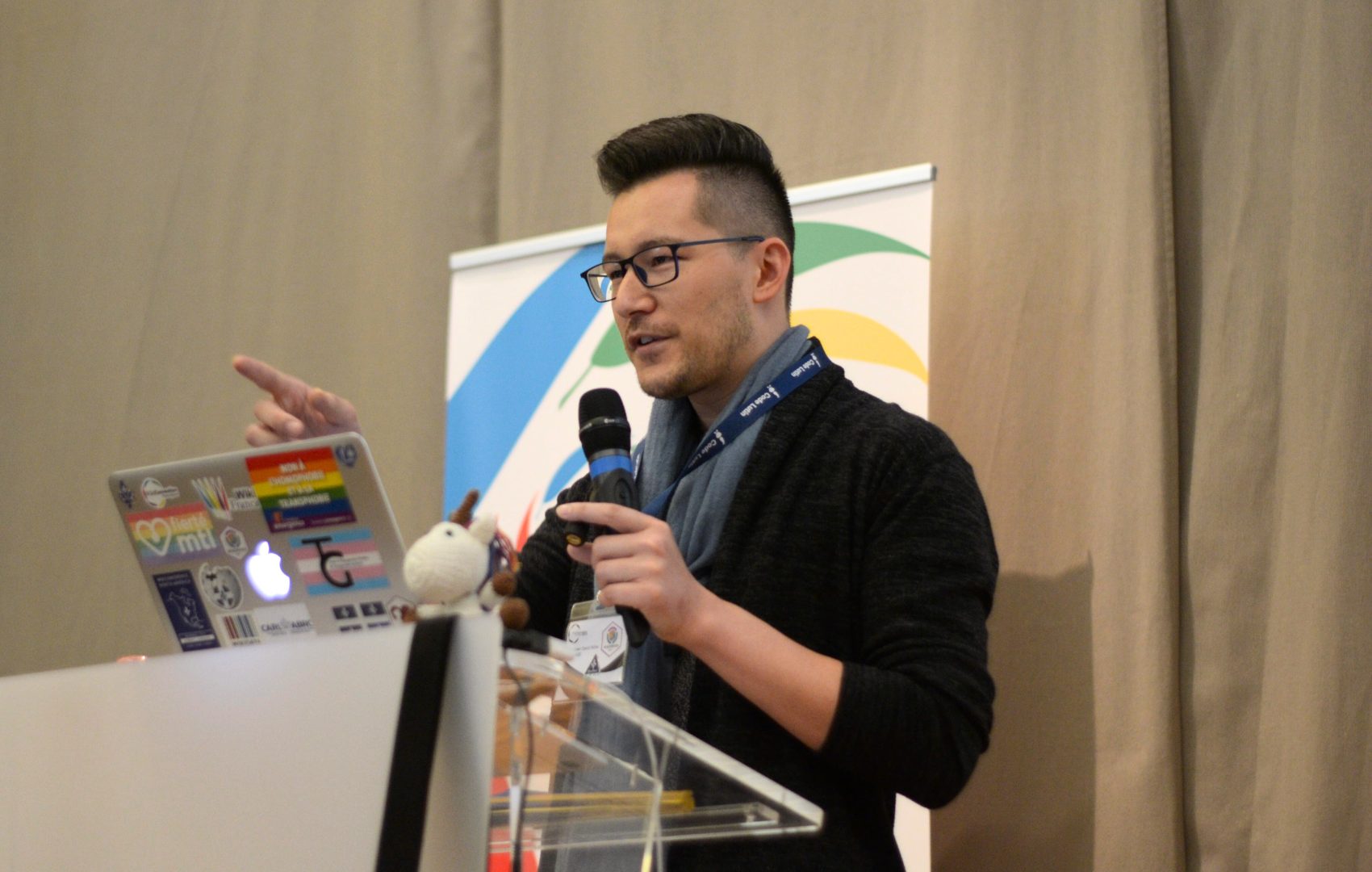
Michael David Miller is Liaison Librarian for French Literature, French Language Learning, Economics, Public Policy and Gender Studies at the McGill Libraries.
He’s also President of Wikimedia Canada, a non-profit organization committed to the growth and development of free knowledge, notably via Wikipedia. The online encyclopedia celebrated its 25th anniversary in January.
Miller is an active volunteer, hosting workshops and edit-a-thons, adding source citations and contributing content – primarily to the French-language version of Wikipedia.
“Librarians have a natural skillset to contribute to these projects,” said Miller. “We have access to primary and secondary sources, we teach workshops on different subjects, and librarians and Wikipedia have similar goals democratizing access to information.”
Wikipedia is one of the world’s most visited websites, comprising more than 66 million articles in a multitude of languages. Yet gaps remain: women, people of colour and LGBTQIA+ community members are historically underrepresented, and Quebec is poorly represented on French Wikipedia.
These gaps can be harmful; not only because “people assume if you’re not on the internet, you’re not important,” said Miller, but because Wikipedia is a significant source of training data for artificial intelligence (AI).
“Not everything is on the internet – someone has to create it first,” said Miller. “And if we don’t create it, AI inaccuracies will fill the gaps.”
The free knowledge movement
Miller joined Wikimedia Canada in 2017 and began contributing to Wikipedia shortly after, primarily in French. One of his first edits was to the page of Montreal drag queen Mado Lamotte, owner of Montreal’s famed Cabaret Mado.
“She’s really well known in Quebec, she’s been on Radio-Canada numerous times, yet there were American drag queens who were much better represented on French Wikipedia,” said Miller. “It confused me – why is that the case?”
Miller discovered approximately 80 per cent of French Wikipedia’s contributors are based in France; all other francophones make up the remaining 20 per cent.
Miller took it upon himself to contribute to French Wikipedia’s underrepresented groups, focusing on Quebec women, people of colour and LGBTQ+ community members. He hosted workshops and edit-a-thons at the Centre communautaire LGBTQ+ de Montréal, resulting in new or enhanced articles dedicated to author Kev Lambert, drag queen Rita Baga and Montreal’s parc de l’Espoir.
His Wikipedia activity often converges with his role as a McGill Librarian: he hosted a Wikipedia workshop for McGill’s communications professionals, collaborated with a French literature class on an assignment that resulted in 17 new Wikipedia articles about female Quebec poets and he has contributed to Wikipedia’s #1Lib1Ref campaign, which invites librarians to add citations to ensure the site is reliable.
Miller is not the only McGill Librarian active in this field; he estimates there are “at least 10 of us who are really well versed in Wiki projects.”
His colleague Anna Dysert, Co-ordinator of Cataloguing and Metadata, Receiving and Processing and Archival Materials, has linked the McGill Libraries Archival Collections Catalogue to relevant Wikipedia pages and Wikidata items. At times nearly half of the digital catalogue’s traffic came from those two sources.
“These platforms help us get our unique items and special collections out into the world,” said Miller. “Things need to be discoverable for people to even know they exist.”
Miller encourages those who haven’t yet played an active role in developing the world’s largest reference website to consider becoming a Wikipedia editor – and he’s here to help. He is available to answer individual Wikipedia questions; he’s also happy to provide information to instructors and professors interested in developing a Wikipedia course assignment and to discuss Wikipedia and the Wikimedia projects as objects of research.
“We’re the McGill Libraries and that’s our job – to keep up to date with information,” said Miller. “You, too, can make a concrete contribution to the free knowledge movement.”