

McGill has embarked on a 10-year partnership with seven Ghanaian institutions and the Mastercard Foundation to better connect Ghana’s youth with employment opportunities in the country’s agri-food sector.
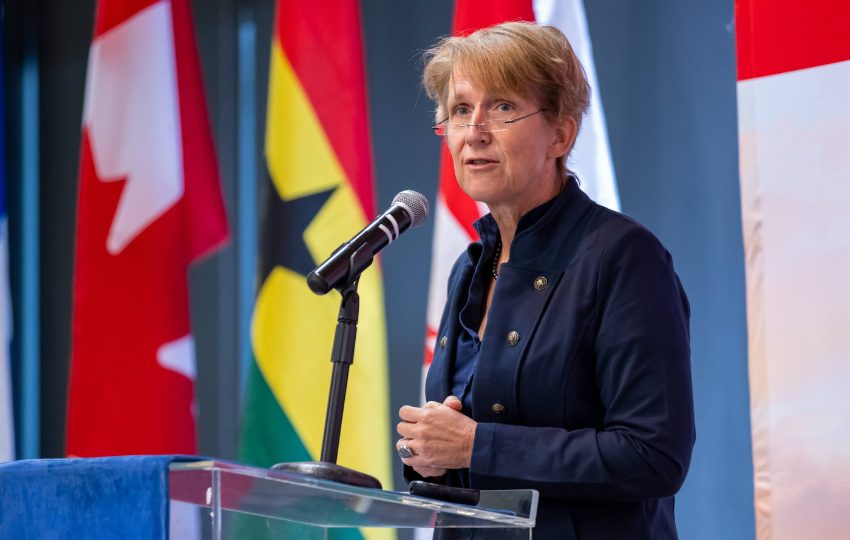
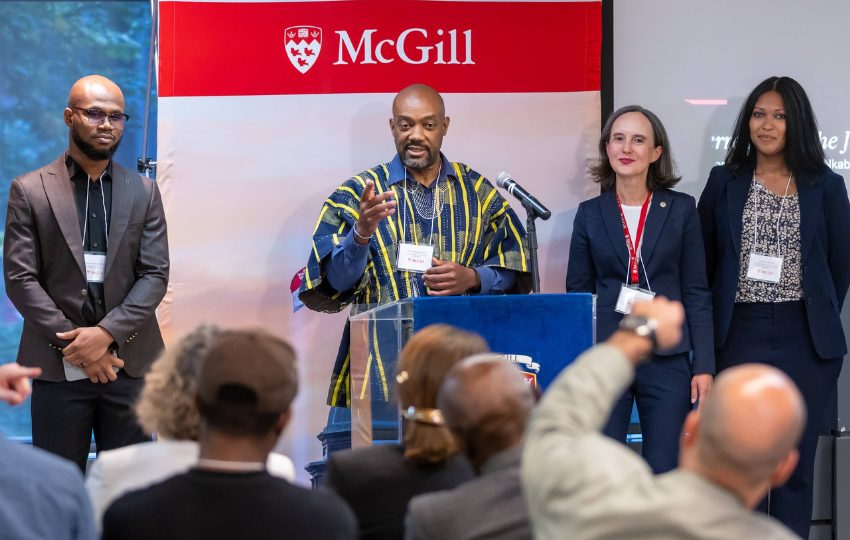
Called the Nkabom Collaborative, the initiative was celebrated at an Aug. 21 event on McGill’s downtown campus. Nkabom means “togetherness” in Akan, a language spoken widely in Ghana.
The Collaborative aims to reimagine food systems, empower young Ghanaians – especially women and members of marginalized groups – and build more inclusive and sustainable communities. This will be done with a focus on education, entrepreneurial opportunities and access to bursaries and mentorships. Moving beyond theory to embrace experiential learning is central to the initiative.
“The Nkabom Collaborative exemplifies the kind of global partnership that McGill University is proud to champion,” said Christopher Manfredi, Provost and Executive Vice-President (Academic). “It brings together leading institutions to co-create solutions rooted in community, engagement, sustainability and innovation.”
In addition to the Mastercard Foundation, McGill’s partner institutions are the Association of Ghana Industries (a non-profit organization representing over 1,200 companies) and six Ghanian universities.
“I’m convinced that we will see the Collaborative become a model for this kind of international relationship,” said Anja Geitmann, McGill’s Vice-President, Global Engagement. “I’m really excited to see it evolve over the next decade.”
Shaping the future of Ghana
The Nkabom Collaborative is closely aligned with Mastercard Foundation’s Young Africa Works Strategy and informed by the African Union’s Comprehensive Africa Agriculture Development Program.
The initiative aligns with 10 of the United Nations’s Sustainable Development Goals.
“We expect that at the end of it all, we will create an ecosystem that will enable us to support a lasting change in Ghana,” said Benjamin Simpson, Professor of Food Science and Agricultural Chemistry at McGill. He is also an alumnus of Kwame Nkrumah University of Science and Technology (KNUST), one of the Ghanaian partner universities.
McGill’s key stakeholders include teams from the Faculty of Agricultural and Environmental Studies (FAES), the Desautels Faculty of Management’s Sustainable Growth Initiative, the School of Population and Global Health and the School of Continuing Studies.
Their Ghanaian counterparts are from Ashesi University, Koforidua Technical University, KNUST, the University of Environment and Sustainable Development, the University of Ghana and the University of Health and Allied Sciences.
At the 10-year mark, the initiative is expected to generate over 30 new or improved academic programs, 5,000 bursaries, 3,000 youth-led agri-food ventures and 55,000 new jobs.
“Beyond the numbers, a true impact will be on the lives of the young people who will see themselves as leaders shaping the future of Ghana,” said Carola Weil, Dean of the School of Continuing Studies. “The goal here is not just to create entrepreneurs, but a whole ecosystem that translates learning into actual jobs and real solutions.”
Creating lasting change
Additional speakers at the launch event included Rica Rwigamba, Country Director, Ghana Programs at Mastercard International; Jeffrey Baikowitz, philanthropist and founder of the non-profit organization Motherfood International; representatives from all seven Ghanian institutions, and closing remarks from Pierre Brunache Jr., Director, Secretariat of the Nkabom Collaborative.
The Secretariat will be based at McGill. This fall, the University will host visitors representing the Ghanaian partners and the Mastercard Foundation.
“By combining our expertise, we’re laying the foundation for a partnership that’s going to create lasting change in nutrition and food security,” said Brunache. “I am confident that we are poised to achieve great things in Ghana and beyond.”