

Derek Hayes, a member of the Gesgapegiag Mi’gmaq First Nation, is pursuing his Bachelor of Education with McGill’s Office of First Nations and Inuit Education (OFNIE) while studying in Eeyou Istchee, the Cree territory in Northern Quebec. For Hayes, participation in the program has become more than about getting a degree – it’s a journey of rediscovery.
Although Mi’kmaq and Cree are different languages, both belong to the Algonquian language family. Through his studies, including two Cree language courses, Hayes has found a linguistic bridge that has inspired him to begin renewing his knowledge of his own Mi’kmaq language.
“Like most of the people my age from my community, I have experienced language loss and when that happens, you don’t know where you fit in anymore.” He explains. “Learning to speak Cree and reconnecting with my own language is bringing me closer to my own deep identity. It has been a great gift.”
By taking courses in Mistissini, Waskaganish, Wemindji and Chisasibi, Hayes has also embraced land-based learning shaped by Cree knowledge – from coastal to inland to northern communities. These experiences have strengthened his passion to carry language and culture into the classroom.
‘Ahead of its time’

The program Hayes is enrolled in is one of those offered by OFNIE in partnership with eight First Nations and Inuit education authorities in Quebec and Labrador. Last semester, about 370 students were in an OFNIE program.
OFNIE celebrates its 50th anniversary this week. Its origins go back to early 1975, when Professor Jack Cram of McGill’s Faculty of Education was invited by the Quebec government to help design an education program for First Nations and Inuit teachers. As a result of his work, in-community education programs began to be offered in Kuujjuaq in the fall of 1975. By 1978, eight graduates were teaching in Inuktitut in Quebec schools, and McGill had begun collaborating with Kativik Ilisarniliriniq to co-develop teacher education programs. The program has since grown considerably.
“In its inception, 50 years ago, OFNIE was a collaborative movement that was ahead of its time in pairing First Nations and Inuit education authorities with an established institute of higher education, serving to inspire and learn from one another,” said Professor Vivek Venkatesh, Dean of the Faculty of Education. “In doing so, these bold educators changed the landscape of learning by co-creating in-community education hubs across the province and by adopting new techniques of culturally centred learning.”
Collaboration and co-creation of programs

This approach to education persists to this day. All the programs offered by OFNIE are co-created with and collaboratively delivered by Indigenous and Inuit education authorities. This collaboration includes shared decision-making about program structure and content, instructional approaches and, to some degree, instructor hiring. Each community that OFNIE works with has different needs, priorities and constraints, such as challenges with internet connectivity or housing availability.
“We strive to ensure that students within each of the Inuit and First Nations communities that OFNIE works with are primarily taught by their own people who have their own very distinct and unique languages, ways of viewing the world, cultural norms and pedagogical practices,” said Geraldine King, who serves, along with Michelle Kennedy, as OFNIE’s interim co-director.
“OFNIE’s goal is ultimately to provide in-community education programs that tend to the educational needs of students from kindergarten to high school in their heritage language, and in the process contribute to the process of language recovery for students across the province,” King said.
While much work remains, OFNIE has come a long way.
“Now, in 2025, OFNIE includes eight distinct partners who continue to co-create programs and support locally governed education throughout Quebec and Labrador through our innovative teacher certification and professional development programs,” Dean Venkatesh said.
“Our OFNIE alumni include elementary and secondary school teachers, curriculum developers, school board administrators and extremely accomplished First Nation and Inuit education authorities,” he said.
Supporting language reclamation
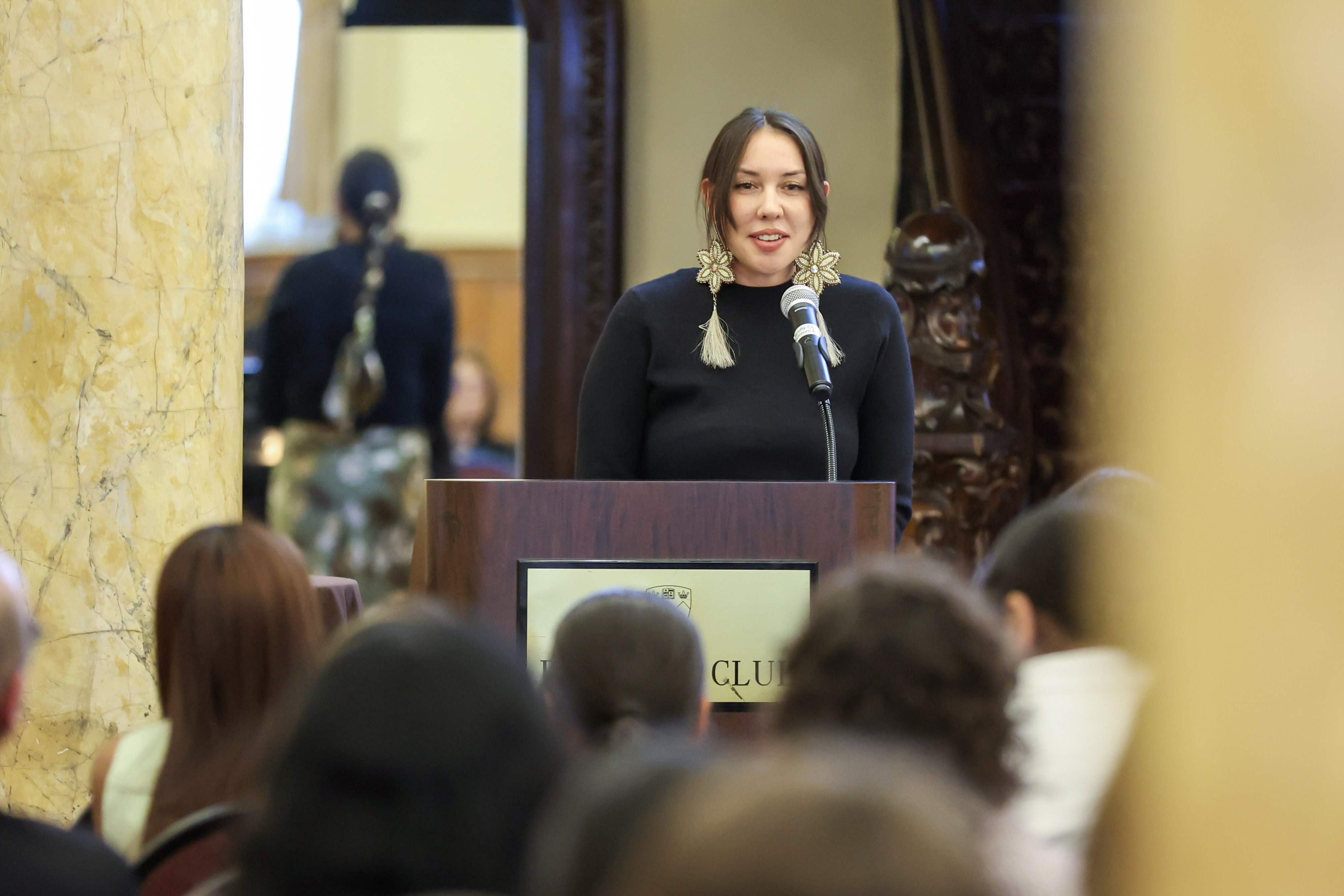
Susie George is one of those OFNIE alumni. A member of the Whapmagoostui Cree Nation, she has worked for over 20 years for the Cree School Board as a teacher, teacher’s assistant, substitute teacher, Cree resource person and special needs educator. In her current role as an Education Consultant in the Professional Development Department, she oversees the Cree Teacher Training programs and juggles a range of tasks involving course creation and teacher training support.
George is part of the team responsible for choosing which courses to offer and spreading the word about the programs to prospective teachers. She also works with 27 students in different communities who are at different stages of studying for their education degrees.
“We do our best to support each and every one of the students in our programs,” said George. “We joke that we have to wear so many hats … sometimes we need to wear therapist hat, sometimes we need a Grandma, or gookum, hat. … I love what I do, and the team I work with.”
In order to improve the learning experiences of young Cree children, Georges is in the process of applying to do an MA in Education. She wants to focus on creating a Cree-phonics to make learning in their own languages easier for future generations.
King, too, stresses the role that language plays in education and in OFNIE’s work:
“Language reclamation and revitalization is taking place at a rapid rate within these communities. Our job is to keep up with those needs, enter into those dynamics and get creative in a way that preserves the cultural sovereignty and integrity of the nations that we work with,” she said.