
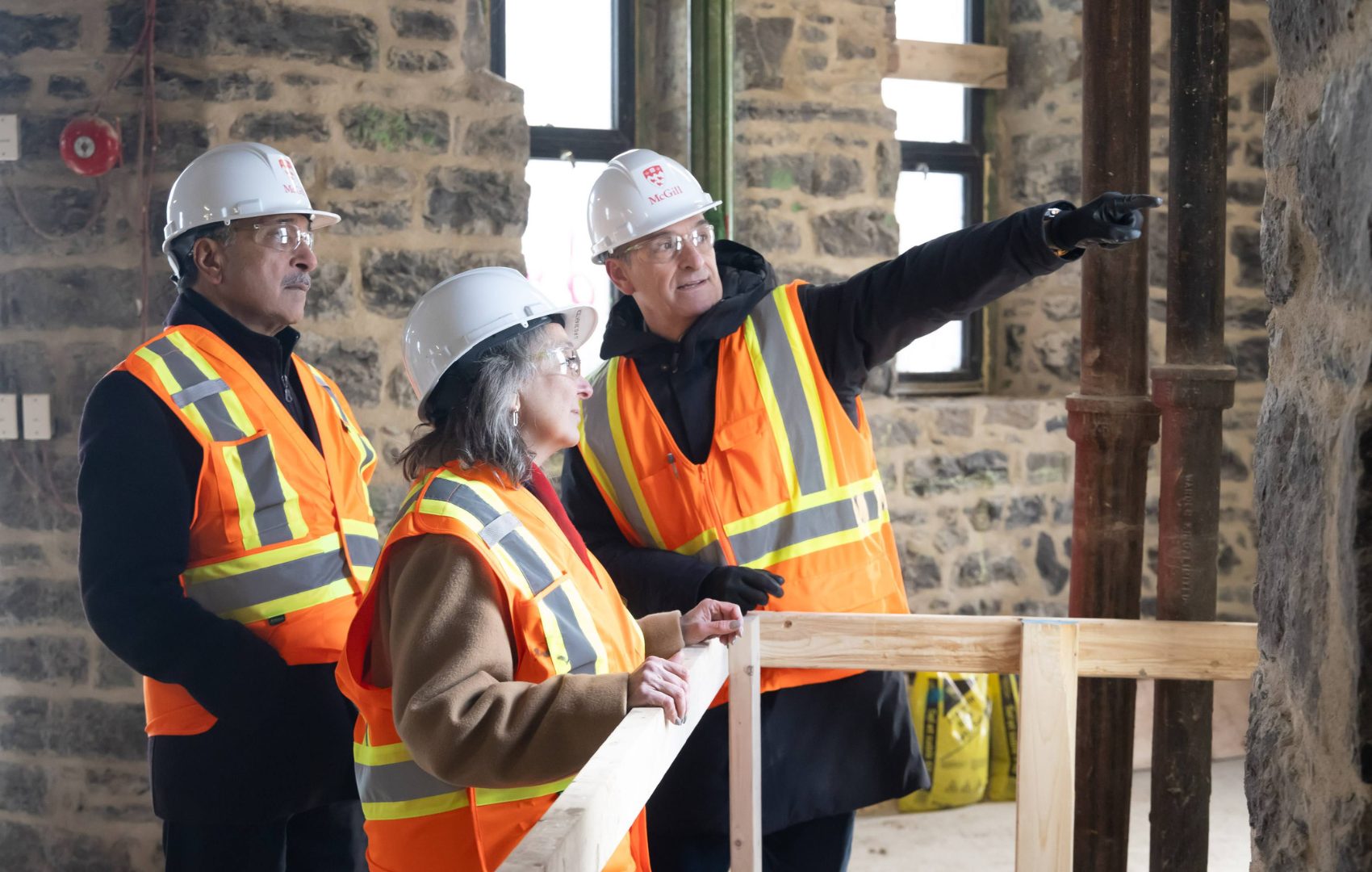
On Feb. 13, Canada’s Minister of Environment, Climate Change and Nature toured the site of McGill’s Sustainability Park. Julie Dabrusin (BA ’94) seemed not only curious to see how her alma mater is changing, but interested in how environmental considerations are being integrated into construction, as well as the vocation of the future spaces.
Among the elements highlighted during the visit was the large number of environmentally friendly geothermal wells: 171 of them, all over 250 metres deep.
“On days when temperatures hover around the freezing mark we would just be running on our geothermal energy,” said Pierre Major, Executive Director of the Sustainability Park. “In the worst winter months, they’d still be providing 50 per cent of our heat.”
Restoration
On top of the geothermal wells will be academic space equivalent to the size of 15 NHL hockey rinks.
To build those spaces, some construction materials are being reused from the deconstruction of the M and S pavilions and the dismantling of the back of the A Pavilion, a postwar addition to the old hospital. Ninety per cent of old materials are being diverted from landfill, surpassing the University’s goal of recycling 75 per cent during construction projects. In addition to saving time and money, this achievement is consistent with McGill’s commitment to become zero waste by 2035.
Concrete was crushed and used in a roadworks project; cast iron radiators were donated to a firm that restores and electrifies them; light fixtures were given to McGill’s student residences; steel was taken from the windows and slabs of marble and Queenston limestone are in storage, to be reused on the same site.
“It’s really cool seeing those materials being repurposed and to know where they’re going,” said Major.
Meanwhile the 130-year-old heritage pavilions are being refurbished. Work on the facade is being done by masons, “but I consider them almost to be artists,” said Major. “They take every stone, clean it, number it and reposition it; it’s really impressive what’s going on.”
Experts even tested bedrock that was exposed during work to see if the stone could be used to rebuild the Sustainability Park’s rubble walls – a suggestion that came directly from the masons.
“When they saw that beautiful rock, they said, ‘Maybe we can use it’,” said Major. “It’s about using what’s already onsite and repurposing it.”
Conservation
If the bedrock is used, it will be one more initiative helping the Sustainability Park divert waste from landfills.
“This is a great example of what’s possible when we think creatively about resources,” said Fabrice Labeau, Vice-President of Administration and Finance. “It shows that sustainability and sound financial management can go hand-in-hand, providing an excellent model for future construction projects at McGill.”

Collaboration
Major estimates the Sustainability Park, which he says is entering its construction phase, is the third-biggest construction project in the Montreal area, behind the Vaudreuil-Soulanges hospital and the refurbishing of the Louis-Hippolyte Lafontaine Bridge-Tunnel.
“We’re actually one foot into what I consider to be the construction stage. Decontamination and major demolition are complete and we’re about to build a permanent element of this project, so for me it’s a sign we’re migrating to a new phase,” said Major.
The project’s size means Major’s team has multiple collaborators. External partners include the city of Montreal, the Société québécoise des infrastructures, the Ministère de l’Enseignement supérieur and the Ministère de la Culture et des Communications.
Within McGill, the team is in regular contact with the Office of the Provost, the Office of Indigenous Initiatives, Procurement Services, Financial Services, Facilities Management and Ancillary Services and their neighbours The Neuro (Montreal Neurological Institute-Hospital) and the Faculty of Medicine.
All have a role to play in advancing the McGill complex, which is expected to open its doors in 2029.
“At this stage, we can say we’re connecting with virtually every unit,” said Major. “Our collaboration brings the project one step closer to welcoming the community into the Park, where the building can finally reclaim its place in daily life.”