
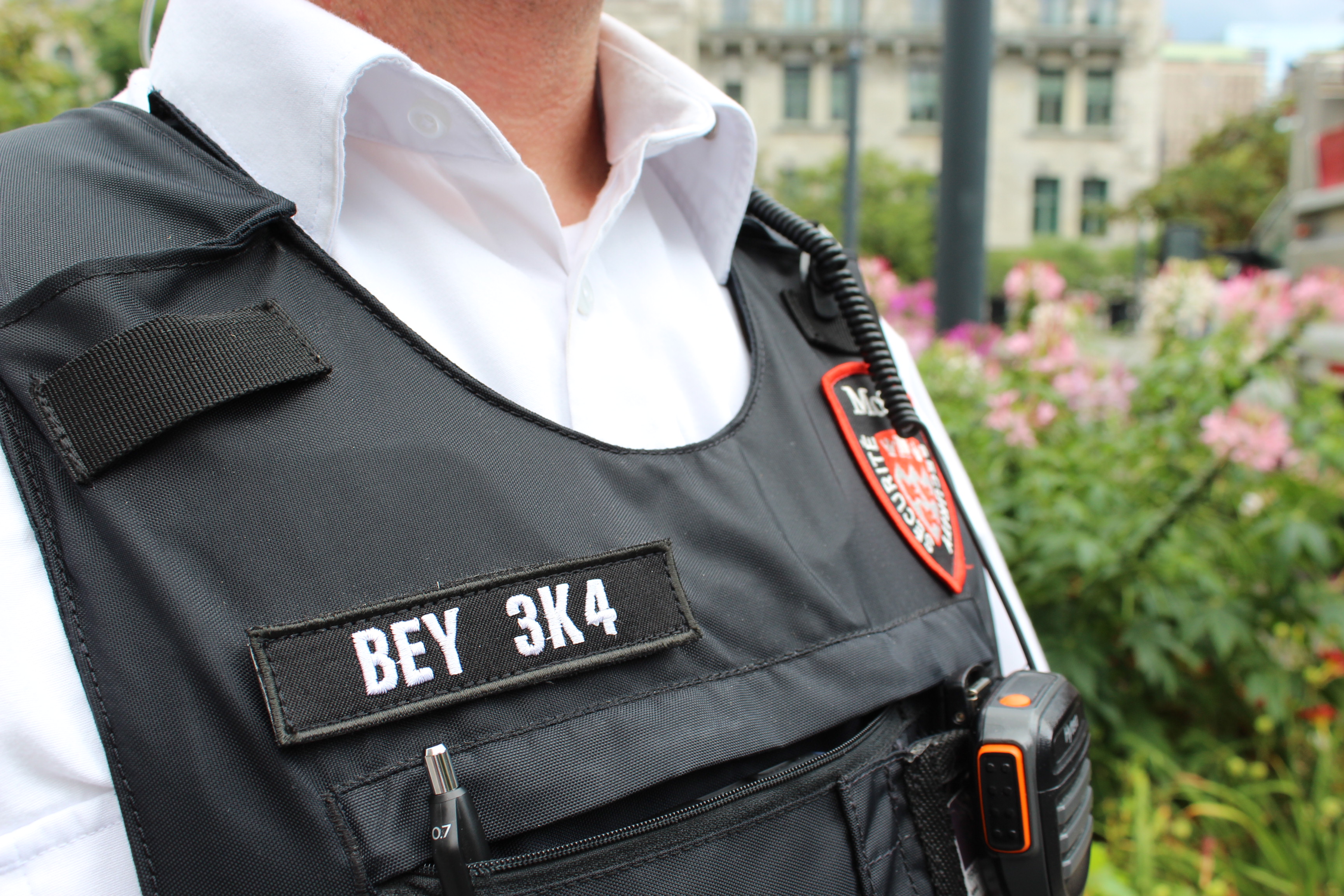
McGill Security Services agents’ badges now feature alphanumerical identifiers – three pronounceable letters and then a number and letter combination – a system recommended by a professor in the Department of Psychology.
In Quebec, security guards don’t have to display their names on their uniform. For some elected student representatives, this was a problem in moments of tension on campus, and they raised the issue at meetings set up by McGill’s Chief Security Officer (CSO) during the 2025-26 term.
“We talked about how unreliable memory can be in tense or stressful situations,” said Naya Wardeh, a recent graduate of McGill’s Cognitive Science Department and former president of the Arts and Science Undergraduate Society. “If IDs are arbitrary strings of numbers, they are hard to remember, especially in the middle of a confrontation.”
CSO Tom O’Neill recognized the concern.
“I asked if any of the students around the table were studying psychology or other fields in which there are experts in memory. Naya put up her hand, then approached a professor of hers,” he said.
Informed by research on memory
“The issue of security agent IDs reminded me of Professor Oliver Hardt‘s lectures on eyewitness accounts in his Intro to Memory class,” recounted Wardeh. “We’d talked about just how unreliable our memory can become in tense or stressful situations. If IDs are arbitrary strings of numbers, I thought, who’s going to remember all of that in the middle of a confrontation? So, I reached out to Professor Hardt about the design issue.”
Hardt agreed to help Wardeh.
“I didn’t provide the system to help Security at McGill. I wanted to ensure that what was done would make sense considering what we know about attention and memory formation under stress, and that it would help students facing a Security Officer,” said Hardt.
“The identifiers are intended to be easy to read and remember, even in emotionally taxing, stressful situations. In short, they are made up of a combination of three pronounceable letters and three numbers.”
Ideally, letter combinations would be reused as little as possible, meaning that a person who retains only the first half on an ID badge would be able to file a report with a significantly reduced risk of misidentification.
More accessible IDs
The new system takes into account visibility, and includes recommendations for fonts, spacing, avoidance of colours and prioritization of distinctive letters and numbers. Hardt also notes that the placement of alphanumeric elements can simplify identification and memory retention for all.
“Using standard distinctiveness measures, the IDs generated were ranked in order of highest likelihood to be encoded and faithfully retained in long-term memory. From the list, I also sought to remove letter combinations that could lead to anyone being ridiculed,” said Hardt.
O’Neill recognized the advantages of the proposed system and sought to institute them as quickly as possible, collaborating with McGill’s Procurement Services to identify a vendor and distribute the new badges over the summer.
O’Neill and Wardeh both consider that the project’s success is thanks to collaboration. For Wardeh, the opportunity to tap into her Cognitive Science learning is also satisfying.
“The design draws on topics we encounter in class, such as chunking, working memory and the primacy effect. Seeing these concepts applied in a real-world problem has also made me re-contextualize what’s possible with my degree,” said Wardeh.
Added O’Neill:
“For us, this is a case of collaboration between students, faculty and Security Services that has led to a practical, needs-based solution. It demonstrates the value of open dialogue, especially among those with diverse experiences.”
For details about the new system and communicating with campus Security Services, visit their webpages.