
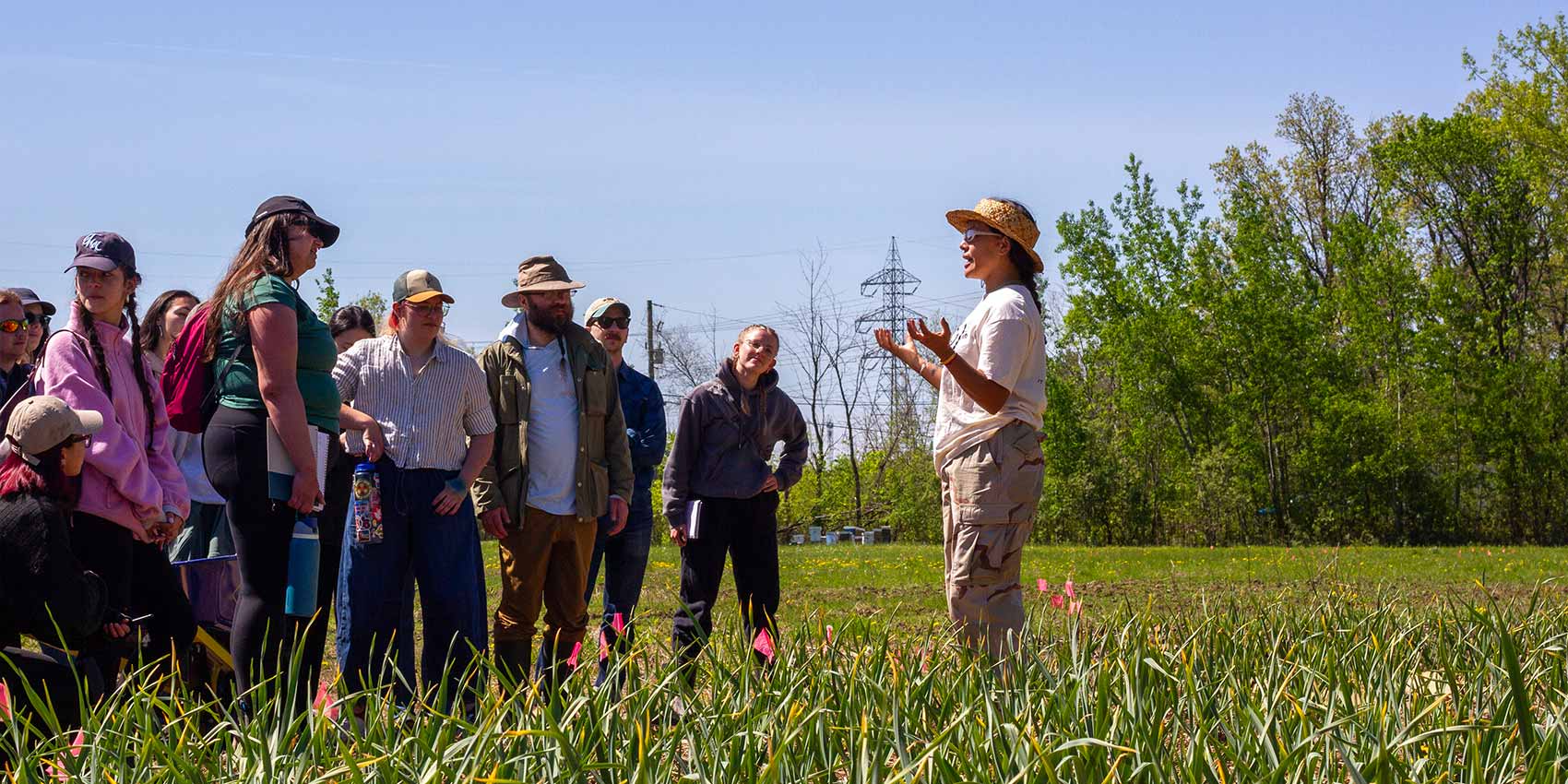
On a sunny morning in late spring, 26 McGill students were tilling the soil in a large field in Kahnawake to help prepare for planting season. The participants in Indigenous Field Studies Course (IDFC 500) had been camping in the Kanien’kehà:ka (Mohawk) territory for the previous week, learning from Elders and other community members and engaging in a tangible act of reconciliation.
The course, which marked its 16th iteration this past summer semester, offers students the opportunity to connect with Indigenous communities near Montreal outside a classroom setting. Indigenous McGill students are among the participants.
“It was great to be outside, out in my community, and to speak to all the members who are driven by Spirit to make positive changes and help heal our community,” said Kanàhne Rice (BSW’27), a member of the Bear Clan and Kahnawake resident who already was establishing deep ties with young mothers in her community. “It was also important to get around the land, connect to it, and do some work here.”
Rice said she originally had been hoping the course would allow her to connect with Kanesatake, another Kanien’kehà:ka community that had sometimes hosted the course in previous years. But, she said, she was excited to participate, nevertheless.
“It reflects my values and how I want to be in the world. I want to work using an interdisciplinary lens and I want to develop relationships wherever I can,” she said. “By talking to my community Elders and learning more about our history, it made me question the systems in place, whether they’re serving us and why they’re still around. It made me think about my place and the work I want to do.”
‘We don’t live in silos’
The course’s interdisciplinary nature is fundamental, explained Nicole Ives, Director of the School of Social Work and course co-founder.
“We don’t live in silos. It made sense to first bring together the disciplines that historically have had the biggest impacts on Indigenous communities,” Ives said.
While currently open to Social Work, Anthropology, Law, and Medicine students – Faculties that have participated since the course’s inception in 2010 – the goal is to involve more disciplines in the future.
“This course is reconciliation in action,” said Ives. “It’s meant to really connect students with the land and the Indigenous Peoples, and to have them learn directly from both.”
New perspectives on previous experiences
For Alex Boos, PhD in Anthropology, the course reinforced learnings from his previous experiences living in Sioux Lookout and Thunder Bay, Ont., where he worked as a social worker at Tikinagan Child & Family Services.
“As I was exposed there to a lot of the chronic violence and trauma people continue to experience from settler colonialism, I also connected with a lot of community members who were re-establishing their spiritual practices through sweat lodges and healing on sacred land,” Boos explained. “I was able to experience first-hand how these ceremonies are integral to that process, which is something that was reinforced during this course, when we got to build a sweat lodge.”
He said he found sharing experiences with Kahnawake community members most impactful.
“I feel like it’s possible to collectively reimagine how we relate to each other and how we can create new social relationships that aren’t demarcated by pre-established systems,” he said. “That’s really promising when we’re faced with a lot of social division, climate anxiety and a general sense of doom.”
‘We have to keep doing the work’
Rayna Sutherland, BCL/JD candidate in the Faculty of Law, was similarly interested in gaining a more nuanced perspective in her field.
Sutherland worked on Parliament Hill for four years, including for the Minister of Crown-Indigenous Relations.
“It was important for me to see the government machinery behind reconciliation from the Crown perspective, even if that was a lot to unpack,” she said.
Like Rice and Boos, Sutherland was interested in the course’s emphasis on community.
“I was able to work really closely with Indigenous leadership and communities in my previous role, but that time was more limited than I would have liked. This course offered me the opportunity to better understand cultural celebrations, Indigenous legal systems and Indigenous community organizing in a way that wasn’t to the beat of politics.”
Sutherland also points to the evolving nature of reconciliation as politics and Indigenous communities continue to change, and the importance of taking time to understand different points of view.
“It’s important for me to keep learning how to work with communities as their realities – and the political landscape – evolve and not just assume I don’t need to learn more because of my previous experience,” she said. “We have to keep doing the work.”