
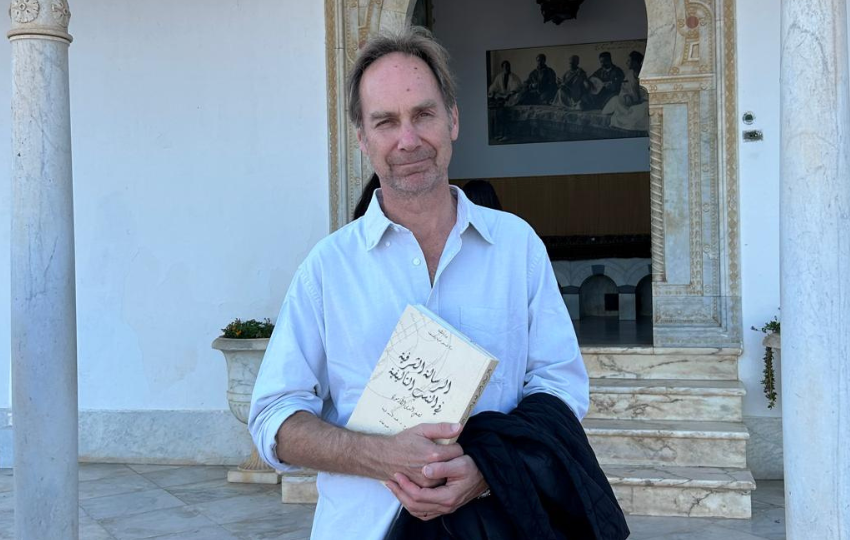
Robert Wisnovsky, a James McGill Professor in McGill’s Institute for Islamic Studies, has been awarded a fellowship at the prestigious Institute for Advanced Study.
Founded in 1930 in Princeton, N.J., the Institute is perhaps best known for its affiliation with Albert Einstein, a former faculty member, and J. Robert Oppenheimer, a past director. (It has no formal link to Princeton University.)
Wisnovsky’s areas of expertise include Islamic philosophy, theology and intellectual history; he will be a member of the Institute’s School of Historical Studies for the Fall 2026 term.
His research work at the Institute will focus on 11th-century philosopher and physician Avicenna, his theories on logic and metaphysics and the reception of his work up until the early 20th century.
“Avicenna was the most influential philosopher in Islamic intellectual history,” said Wisnovsky. “Anything that advances our understanding of the richness and complexity of that history will help to correct persistent misconceptions about the nature and scope of Islamic religion and civilization more broadly.”
He added that the institute has a long tradition of excellence in Islamic studies.
A foremost scholar in his field
Wisnovsky earned degrees from Yale and Princeton, then completed a postdoctoral role at King’s College London. He taught Islamic Intellectual History at Harvard prior to arriving at McGill, where he served two terms as Director of the Institute of Islamic Studies (ISS).
Khalid Medani, current Director of the ISS, spoke highly of his contributions
“We at IIS know full well this well-deserved recognition appropriately acknowledges Prof. Wisnovsky’s many years of scholarly productivity, which have made him one of the foremost scholars in his field. We have no doubt he will use this opportunity to once again produce exemplary scholarship in the field of Islamic philosophy, and Islamic studies more broadly.”
The Institute for Advanced Study welcomes more than 250 of the most promising researchers from around the world every year, who are selected through a highly competitive process for their bold ideas, innovative methods and deep research questions.
The Institute’s past and present scholars include 37 Nobel laureates, 49 Fields medalists and 25 of the 29 Abel Prize laureates, as well as Turing Award winners, MacArthur and Guggenheim fellows and recipients of the Wolf, Holberg, Kluge and Pulitzer prizes.