
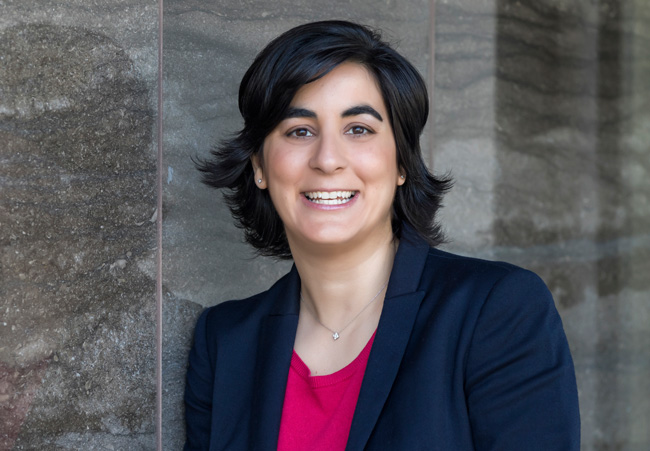
Nathalie Tufenkji has been named the 2026 recipient of Quebec’s Prix Marie-Victorin for her research on plastic pollution, water treatment and environmental health. The McGill University professor and Canada Research Chair in Biocolloids and Surfaces studies how tiny particles move through water and the environment, the risks they may pose and how they can be removed.
The prize, one of 18 Prix du Québec awarded by the Quebec government, recognizes excellence in natural sciences and engineering. This year’s Prix du Québec recipients also included McGill professor Nada Jabado, an expert in pediatric brain cancers, who received the Prix Wilder-Penfield.
“Professor Tufenkji’s internationally recognized research has expanded the frontiers of environmental engineering while helping to tackle critical challenges, including the global crisis of plastic pollution in soils and freshwater,” said Dominique Bérubé, Vice-President, Research and Innovation.
“Combined with her dedication to mentoring the next generation of scientists and engineers, her contributions have strengthened Quebec’s research-leadership and capacity to innovate. We are grateful to the Quebec government for recognizing researchers whose excellence, vision and impact help shape a better future for all,” Bérubé said.
From karate to chemical engineering
Tufenkji’s path to environmental engineering began with a fellow karate student.
As a teenager, she trained toward her black belt with an older student who worked as a chemical engineer in the environmental field. Near the end of CEGEP, when she was considering studying chemistry but unsure which university program to choose, he suggested chemical engineering.
Tufenkji had been fascinated by science since childhood.
“I read every book on Marie Curie and Louis Pasteur I could get my hands on,” she said. So, when her teammate suggested chemical engineering, she took his advice. They remained friends and, when she graduated from McGill in 1999, he was there to present her with the Iron Ring.
Tufenkji pursued graduate research in environmental engineering, focusing on the behaviour and removal of tiny particles in water, including microorganisms and inorganic particles. She later applied that expertise to engineered nanomaterials and, as concern about plastic pollution grew, to microplastics.
“My experience in nanomaterials gave me a natural entry point into the field of microplastics,” she said. “I wanted to understand how they behave, where they’re coming from, where they’re ending up in the environment, and what the potential impacts are.”
From nanomaterials to microplastics
Tufenkji’s work has included studies of microplastics in bottled water and particles released by plastic tea bags, both of which attracted widespread media attention.
Her research has been cited more than 30,000 times, including in more than 80 policy documents around the world, among them United Nations reports.
Tufenkji has also advised governments on plastic pollution and served on expert groups examining environmental risks and research priorities.
She and her collaborators have also developed new approaches to water treatment, including recycled-cellulose materials that capture contaminants while reducing the need for conventional chemicals. The project received the Honoris Genius Award for Sustainable Development from the Ordre des ingénieurs du Québec.
Her group has also studied compounds derived from cranberries and maple syrup that make some bacteria more vulnerable to antibiotics, an area of research that could help address antibiotic resistance.
The common thread, she said, is a desire to work on problems that matter outside the lab.
“The goal of all researchers is for their work to have some kind of impact,” she said. “Everyone is adding a little piece to the puzzle.”
‘Research is teamwork’
Tufenkji has mentored more than 200 researchers at McGill. Many have gone on to careers in academia, government and industry.
At the University, she has taught undergraduate and graduate students while leading her research group. She credits her students, postdoctoral researchers and collaborators with driving the work forward.
“Research is teamwork,” she said. “It takes a lot of different people, coming from different areas of expertise, working together to answer complex questions.”
“You can have great ideas and funding, but if you can’t work with brilliant people who are motivated and committed to the project, it’s never actually going to turn into anything.”
Her group is increasingly focused on nanoplastics, which are much smaller than microplastics and therefore harder to detect and measure. The researchers are also developing technologies to remove plastic particles from sources that supply drinking water plants and from wastewaters.
For Tufenkji, the larger purpose of her work is to help people better understand the environmental challenges around them, including providing knowledge and tools to address them.
“We share this one planet, and we all have to work together toward making it better,” she said.
Other 2026 Prix du Québec recipients with McGill connections include alumnae Julie Desrosiers (LLM’99, DCL’05) and Marie-Josée Lacroix (MLIS’85), and former postdoctoral fellow Mathieu Lapointe.