
McGill University and many of its buildings are named after people who helped shape it over the last two centuries. While some recognize major donors, others were named for McGillians who left a significant mark on the community.
To honour the university’s commitment to taking a more inclusive approach, the Office of the Provost is launching a process, open to everyone.
“Names help tell the story of the University,” said Tynan Jarrett, Director of Equity, Diversity and Inclusion, in the Office of the Provost. “This initiative gives us an opportunity to recognize trailblazers while better reflecting the diversity of the communities that have shaped McGill. As acknowledged in McGill’s strategic EDI plan, we risk alienating people when they do not see themselves represented in our physical spaces.”
Simplifying the process for nominations
While McGill already has a policy for the naming of assets, both tangible, like spaces and equipment, and intangible ones, like programs and awards, how to put it in action was less obvious.
“Imagine you’re a student who learns about a McGill graduate whose story resonates with you –someone who has made an outstanding contribution to their community or had a significant impact beyond the University. How would you go about proposing that McGill recognize their contributions by naming a space in their honour?” asked Jarrett.
To make it easy to nominate people, the Advisory Committee for Honorific Naming has launched a new web form. It removes the need to prepare a detailed naming proposal by providing some guiding questions that aim to collect just enough information to allow the committee to undertake an initial evaluation.
“Once we have identified people who have made lasting contributions, and understand their connections to McGill, we can begin to consider which campus spaces might be appropriate to recognize them and their legacies,” added Jarrett.
Bringing names and stories forward
Broadening honorific naming has been recommended by some of the University’s key action plans, including McGill’s 52 Calls to Action to advance Reconciliation and the Anti-Black Racism Plan.
“There are names we know because institutions carved them into stone. And there are names we know because our communities refused to let them be forgotten,” said Maurice Riley Case Associate Director, Black Inclusion, Success, and Strategic Initiatives. “They belong to people who opened doors, challenged exclusions, created knowledge, cared for others and made paths where none existed before.”
Riley Case said he hopes the honorific naming initiative will provide an opportunity for “future generations encounter the names of Black people not at the margins of McGill’s history, but within the everyday life of the University.”
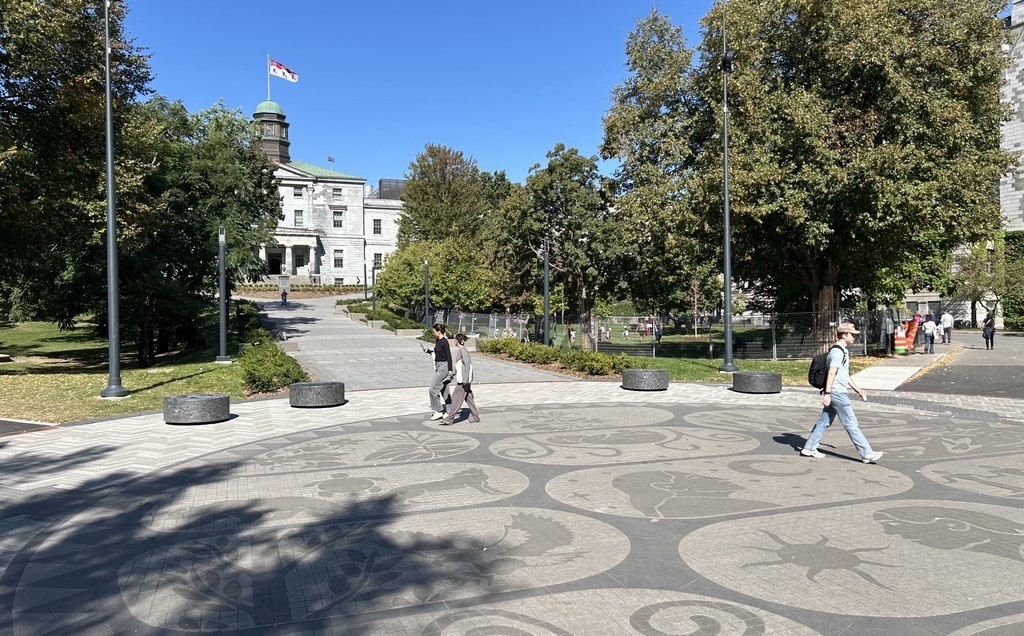
McGill’s Indigenous members and partners have also been pushing for more inclusion of Indigeneity in campus spaces, which is the goal of Call to Action 26. The most notable project to date is the redesign and naming of the lower campus intersection, now the Tsi Non:we Onkwatonhnhets, or “The Place Where Our Life Force Emerges from the Earth.”
“We worked closely with local Indigenous artists, cultural advisors, our colleagues at Facilities Management and many others, to reimagine and name the intersection in a way that integrates an Indigenous worldview into a practical and beautiful meeting space. In design and name, it reflects Kanien’kehá:ka history and themes, honouring the land on which McGill is situated,” said Celeste Pedri-Spade, Associate Provost (Indigenous Initiatives).
Natallia Liakina, Associate Provost, Rayonnement du français, points out that the honorific naming initiative also aligns with McGill’s President’s priority of local engagement and McGill’s place in Quebec.
“Honorific naming offers an opportunity to recognize the contributions of francophone members of the McGill community, alongside those of the many communities that have shaped the University. Making these stories more visible in our campus spaces can strengthen a sense of belonging among francophones at McGill and help the wider community discover this shared heritage,” said Liakina.
To learn more about the new honorific naming initiative, and to view the nomination form, please visit the Provost’s Office webpage. Community members will also have an opportunity to ask questions through an information session, at 2 p.m. on Nov. 23.